
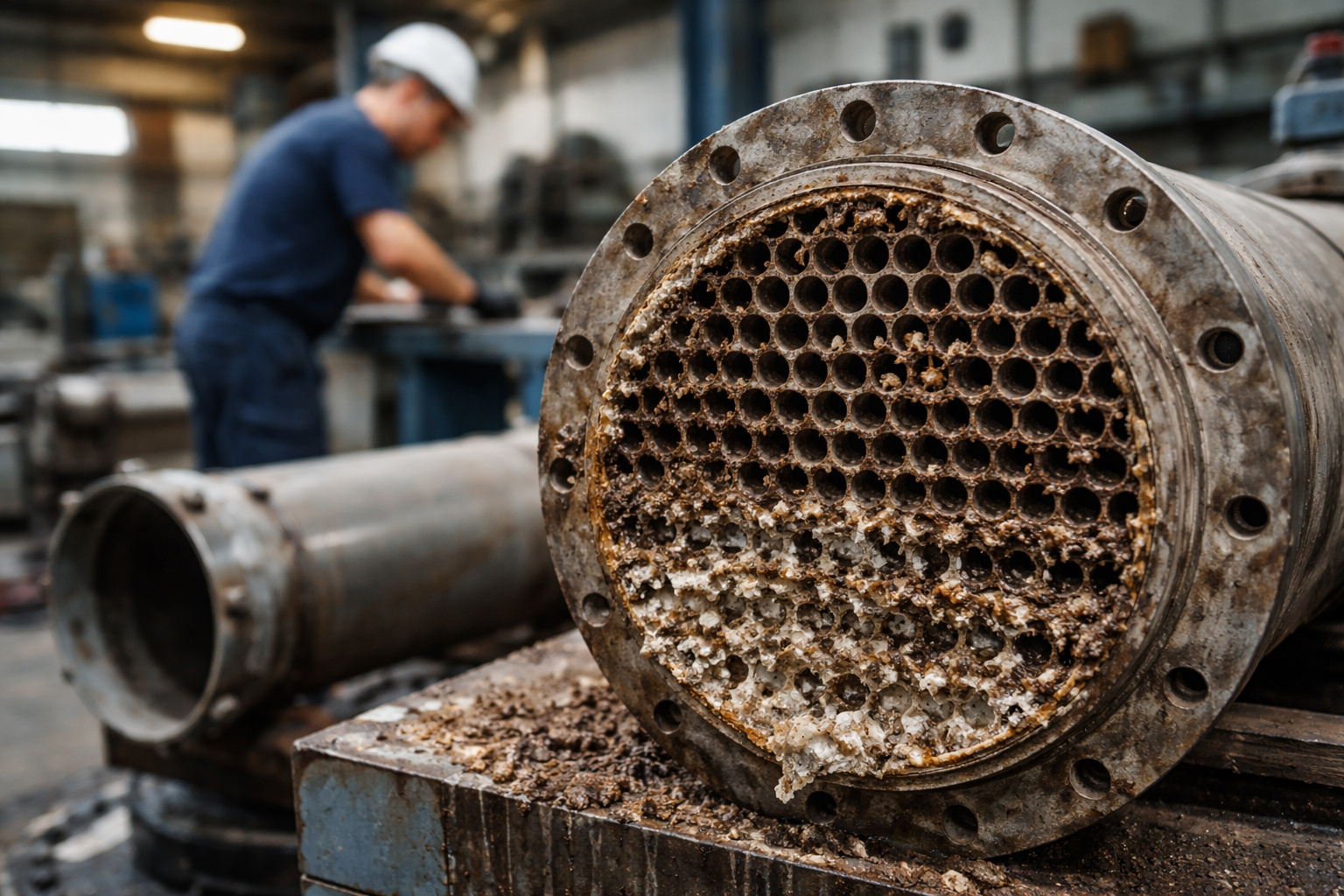
Heat Exchanger Fouling: How It Impacts Performance & Downtime
In most Ontario industrial facilities, heat exchangers are designed with a built-in fouling margin. Engineers know that some level of deposit buildup is inevitable, so they account for it in the original sizing and performance calculations.
The problem starts when real-world heat exchanger fouling exceeds those assumptions.
When fouling progresses beyond expected levels, performance begins to drift. Outlet temperatures miss target. Pressure drop increases. Cleaning intervals shorten. Energy use creeps up. What was once predictable becomes reactive.
For plant managers, maintenance managers, and reliability engineers, heat exchanger fouling isn’t just a maintenance issue, it’s a reliability and cost control issue.
Understanding how heat exchanger fouling affects performance, and when cleaning stops being the full solution, is critical to protecting uptime.
What Is Heat Exchanger Fouling?
Heat exchanger fouling refers to the accumulation of unwanted material on internal heat transfer surfaces. These deposits create an additional layer of thermal resistance between the process fluid and the metal surface.
In simple terms:
Fouling adds insulation where you need heat transfer.
Common types of heat exchanger fouling in industrial operations include:
- Scaling – Dissolved minerals precipitate out of solution when temperature or chemistry changes, forming hard deposits.
- Particulate fouling – Suspended solids settle in low-velocity areas or become trapped in plate channels or tube bundles.
- Biological fouling – Biofilms form in systems using untreated or inadequately treated water.
- Corrosion fouling – Oxides or corrosion by-products accumulate and create rough surfaces that encourage further buildup.
From a design perspective, engineers include a fouling factor when sizing heat exchangers. However, when actual operating conditions accelerate deposit formation, performance degradation can move quickly beyond what the exchanger was designed to handle.
How Heat Exchanger Fouling Impacts Performance
Heat exchanger fouling affects both thermal efficiency and hydraulic performance. These impacts show up directly in plant operating data.
For a deeper look at how fouling affects performance and downtime, including pressure drop and energy efficiency, see our article on heat exchanger fouling performance impacts.
Reduced Heat Transfer Efficiency
As fouling builds up, thermal resistance increases and the overall heat transfer efficiency of the exchanger decreases.
You may notice:
- Higher approach temperatures
- Difficulty reaching process setpoints
- Longer heating or cooling cycles
- Reduced capacity under peak demand
To compensate, operators may increase flow rates, raise temperature differentials, or push upstream systems harder.
This maintains production, but increases energy demand and equipment stress.
Increased Pressure Drop
Heat exchanger fouling also restricts flow.
In shell & tube exchangers, deposits reduce internal tube diameter and disrupt flow distribution. In plate heat exchangers, narrowing of channels increases velocity and frictional resistance.
As effective flow area decreases:
- Pressure drop rises
- Pump load increases
- Energy consumption increases
- Flow imbalance may worsen
Rising pressure differential across the exchanger is often an early indicator of advancing fouling.
Higher Energy Consumption
When heat transfer efficiency declines and pressure losses rise, supporting equipment must compensate.
Boilers may operate longer. Chillers may cycle more frequently. Pumps may draw additional power.
Over continuous operation, even modest efficiency losses caused by heat exchanger fouling can translate into measurable increases in energy use.
The Link Between Fouling and Equipment Damage
Heat exchanger fouling is not only a performance issue, it can also affect material integrity.
Deposits may create localized environments that:
- Trap moisture
- Concentrate corrosive species
- Restrict oxygen diffusion
These conditions can accelerate under-deposit corrosion, leading to pitting and wall thinning beneath the fouling layer.
In shell & tube heat exchangers, this may appear as localized tube degradation.
In plate heat exchangers, it may compromise plate surfaces or gasket sealing areas.
Cleaning removes deposits. It does not restore lost metal thickness.
When heat exchanger fouling becomes persistent or accelerates unexpectedly, it may indicate deeper structural concerns.
Cleaning vs. Repair: When Is Cleaning Not Enough?
Cleaning is often the first response to heat exchanger fouling, and in early stages, it is appropriate.
When Cleaning Is Effective
Cleaning may be sufficient when:
- Performance returns close to baseline after service
- Pressure drop normalizes
- Inspection reveals no structural damage
- Cleaning intervals remain consistent over time
Mechanical cleaning, hydroblasting, chemical descaling, and CIP methods can effectively restore performance when the exchanger remains structurally sound.
When Repair Should Be Considered
If you are seeing:
- Shorter intervals between cleanings
- Persistent pressure drop even after cleaning
- Evidence of pitting or tube thinning
- Repeated gasket failures in plate exchangers
- Cross-contamination between process streams
The issue may extend beyond surface fouling.
For shell & tube heat exchangers, repair may involve tube replacement, retubing, or tube sheet repair. Learn more about our shell & tube heat exchanger repair services.
For plate heat exchangers, regasketing or plate replacement may be required to restore reliable sealing and thermal performance. See how our plate heat exchanger repair services restore performance and integrity.
Cleaning addresses buildup. Repair addresses integrity.
Understanding the difference helps prevent recurring downtime and escalating lifecycle costs. To understand how chronic fouling affects performance and reliability — and when repair becomes a better option, read our detailed article on heat exchanger fouling performance impacts.
How to Prevent Excessive Heat Exchanger Fouling
While heat exchanger fouling cannot be eliminated entirely, it can be managed proactively.
Monitor Performance Trends
Track:
- Temperature differentials
- Pressure drop
- Cleaning frequency
- Energy consumption
Gradual changes often signal developing fouling before it impacts production.
Operate Within Design Conditions
Heat exchangers are designed for specific flow velocities and temperature ranges.
Operating below recommended velocities can increase sedimentation.
Excessive velocities can contribute to erosion and surface damage.
Maintaining stable operating conditions reduces fouling risk.
Combine Cleaning With Inspection
Each cleaning event is also an opportunity to inspect internal surfaces for corrosion, wall thinning, and gasket degradation. Our heat exchanger inspection services help identify structural concerns before they lead to unplanned downtime.
The Cost of Ignoring Heat Exchanger Fouling
Unchecked heat exchanger fouling can lead to:
- Increased energy consumption
- More frequent maintenance shutdowns
- Production instability
- Premature equipment replacement
What begins as a performance issue can evolve into a reliability risk if not addressed strategically.
Protect Performance Before Downtime Escalates
Heat exchanger fouling is a predictable part of industrial operation. Escalating downtime is not.
If your shell & tube or plate heat exchangers are experiencing declining performance, rising pressure drop, or increasingly frequent cleaning cycles, it may be time to evaluate whether the issue is surface-level or structural.
A condition-based assessment can clarify the next step.
Contact us to explore heat exchanger repair options
Reliable uptime depends on equipment that’s structurally sound.
Frequently Asked Questions About Heat Exchanger Fouling
What causes heat exchanger fouling?
Heat exchanger fouling is caused by the accumulation of unwanted materials on internal heat transfer surfaces. The most common causes include:
- Mineral scaling due to changes in temperature or fluid chemistry
- Suspended solids settling in low-velocity areas
- Biological growth in untreated or inadequately treated water systems
- Corrosion by-products forming rough surfaces that trap additional deposits
Operating outside of design flow rates, poor water quality, and inconsistent maintenance practices can accelerate fouling rates.
How does heat exchanger fouling affect efficiency?
Heat exchanger fouling reduces efficiency by increasing thermal resistance between the process fluid and the metal surface.
As fouling builds up:
- The overall heat transfer efficiency decreases
- The exchanger may struggle to reach temperature setpoints
- Boilers, chillers, and pumps must work harder to compensate
Over time, this leads to higher energy consumption and reduced thermal performance.
How can you tell if a heat exchanger is fouled?
Common indicators of heat exchanger fouling include:
- Rising pressure drop across the exchanger
- Higher approach temperatures
- Reduced heating or cooling capacity
- Shorter intervals between required cleanings
- Increased energy usage under normal operating loads
Trend monitoring of pressure differential and temperature performance is one of the most effective ways to detect developing fouling early.
How often should a heat exchanger be cleaned?
There is no universal cleaning interval for heat exchangers. The frequency depends on:
- Fluid quality
- Operating temperatures
- Flow velocity
- Process chemistry
- Equipment design
Rather than relying on fixed schedules, many facilities use performance-based indicators, such as pressure drop or heat transfer efficiency, to determine when cleaning is necessary.
If cleaning frequency increases over time, it may indicate underlying surface or material issues.
When is repair required instead of cleaning?
Repair should be considered when cleaning no longer restores performance or when inspection reveals structural damage.
Signs that repair may be required include:
- Tube wall thinning or pitting
- Persistent pressure drop after cleaning
- Repeated gasket failures in plate exchangers
- Leaks or cross-contamination between streams
- Accelerating fouling cycles
Cleaning removes deposits. Repair restores structural integrity.
Can heat exchanger fouling cause equipment failure?
Yes. If left unmanaged, heat exchanger fouling can contribute to:
- Under-deposit corrosion
- Tube degradation
- Reduced mechanical integrity
- Flow blockages
- Unplanned shutdowns
While fouling itself may begin as a performance issue, prolonged buildup can increase the risk of mechanical damage and unexpected downtime.
Is heat exchanger fouling preventable?
Heat exchanger fouling cannot usually be eliminated entirely, but it can be controlled.
Effective strategies include:
- Maintaining proper water treatment and filtration
- Operating within design flow conditions
- Monitoring pressure drop and temperature trends
- Inspecting internal surfaces during cleaning cycles
Proactive monitoring and condition-based maintenance significantly reduce the risk of severe fouling and unplanned repair.